Estimated reading time: 10 minutes
Healthcare professionals often use the terms IV training and IV certification interchangeably.
But they are not necessarily the same thing.
If you’re a nurse, EMT, paramedic, medical professional, or other healthcare professional interested in expanding your knowledge of intravenous therapy, understanding the difference between training, education, certification, and credential renewal can help you make more informed decisions about your professional development.
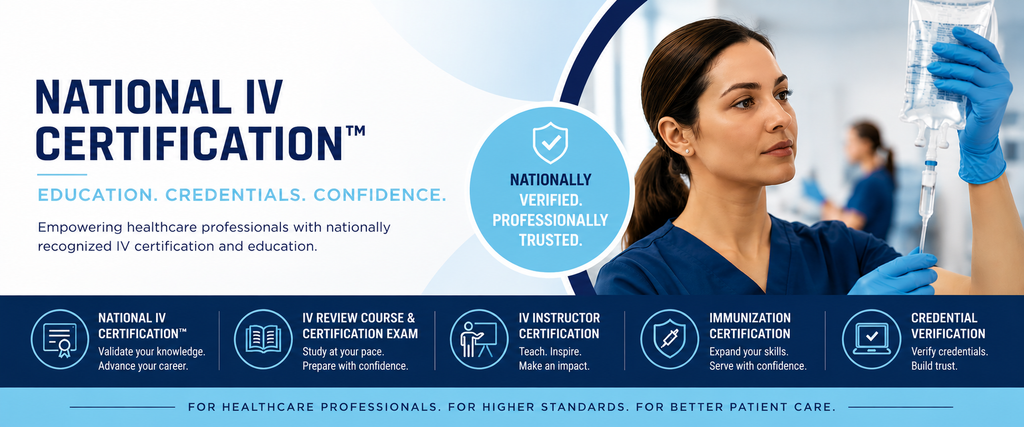
At the National IV Association (NIVA), education and certification are designed to support healthcare professionals in strengthening their knowledge of IV therapy while promoting professional standards, patient safety, and continued development. (National IV Association)
So, what exactly is the difference?
Table of contents
- Quick Answer: What Is the Difference Between IV Training and IV Certification?
- What Is IV Training?
- What Is IV Certification?
- IV Training vs. IV Certification: A Simple Comparison
- Do You Need IV Training Before IV Certification?
- What Should You Look for in an IV Training Program?
- 2. What Topics Does the Course Cover?
- 3. Is the Training Designed to Prepare You for Certification?
- What Does the NIVA IV Certification Pathway Include?
- Does Completing IV Training Mean You Are Certified?
- Why Certification and Education Can Work Better Together
- IV Certification Is Not the Same as Scope of Practice
- How Do You Know Which IV Pathway Is Right for You?
- Consider Certification If:
- Consider Instructor Certification If:
- How to Prepare for an IV Certification Exam
- Explore Your NIVA Certification Pathway
- Frequently Asked Questions About IV Training and Certification
Let’s break it down.
Quick Answer: What Is the Difference Between IV Training and IV Certification?
IV training focuses on learning.
Training and education help healthcare professionals build or review knowledge related to IV therapy, procedures, patient care, safety, and professional responsibilities.
IV certification focuses on demonstrating knowledge.
Certification typically involves meeting eligibility requirements and successfully completing an assessment or examination established by the certifying organization.
In simple terms:
Training helps you learn.
Certification helps you demonstrate your knowledge and competency according to the requirements of a certification program.
For many healthcare professionals, these two components can work together as part of a broader professional development journey.
What Is IV Training?
IV training refers to education designed to help healthcare professionals learn, review, or strengthen their understanding of intravenous therapy.
Depending on the program and professional role, IV education may cover topics such as:
- IV equipment and terminology
- Peripheral IV access
- Patient assessment
- Infection prevention
- IV safety
- Documentation
- IV therapy concepts
- Monitoring IV equipment
- Recognizing potential complications
- Professional responsibilities
- Patient communication
The exact content and level of training can vary significantly depending on the educational provider, course, professional role, and applicable scope of practice.
The purpose of IV training is to build knowledge.
For someone who is new to IV-related concepts, training may provide a foundational introduction.
For an experienced healthcare professional, a review course may help refresh existing knowledge and prepare for an examination or professional credential.
NIVA’s educational approach includes online review courses and educational resources designed to support healthcare professionals preparing for national certification. (National IV Association)
What Is IV Certification?
IV certification is a professional credentialing process that generally requires a candidate to meet the requirements established by a certifying organization and successfully complete the required examination or assessment.
A certification process may evaluate a candidate’s understanding of areas such as:
- IV procedures
- Patient safety
- Documentation
- IV equipment
- Professional responsibilities
- Identification and monitoring of IV-related concerns
- Appropriate communication and escalation
The NIVA National IV Examination is designed to assess healthcare professionals’ knowledge related to IV catheter placement, documentation, IV therapies, equipment, complications, and patient safety. (National IV Association)
Certification is not simply completing a course.
This is one of the most important distinctions healthcare professionals should understand.
Completing an educational course may demonstrate that you participated in training.
A certification credential involves a separate process established by the certifying organization.
Depending on the pathway, a course and certification exam may be offered together or separately.
IV Training vs. IV Certification: A Simple Comparison
| IV Training | IV Certification |
| Focuses on education | Focuses on credentialing |
| Helps build or review knowledge | Evaluates knowledge through an established process |
| May include lessons and educational materials | May require successfully completing an exam |
| Can support professional development | Can provide a professional credential |
| May help candidates prepare for certification | Demonstrates successful completion of certification requirements |
The best pathway depends on where you are in your professional journey.
Some healthcare professionals may already have extensive IV experience and primarily need to prepare for a certification exam.
Others may want a structured review course before pursuing certification.
Do You Need IV Training Before IV Certification?
The answer depends on several factors, including:
- Your current professional experience
- Your educational background
- Your role in healthcare
- Your existing IV knowledge
- The certification organization’s requirements
- Applicable state laws
- Employer policies
- Your professional scope of practice
Some healthcare professionals already perform IV-related responsibilities as part of their professional role and may be looking for a way to validate or formally document their knowledge through certification.
Others may feel that they need additional education or review before taking a certification examination.
A review course may be particularly helpful if:
- You have been away from clinical practice
- You want to refresh your IV knowledge
- You are preparing for a certification examination
- You want structured educational material
- You prefer self-paced learning
- You want to identify areas where you need additional review
NIVA currently offers a self-paced National IV Review Course alongside certification and exam pathways. (National IV Association)
What Should You Look for in an IV Training Program?
Not all educational programs are the same.
Before enrolling in an IV course or training program, healthcare professionals should consider several important questions.
1. Who Is the Course Designed For?
Start by identifying whether the course is appropriate for your professional role.
Consider:
- Nurses
- EMTs
- Paramedics
- Other licensed healthcare professionals
- Healthcare professionals seeking continuing education
- Candidates preparing for certification
Understanding the intended audience can help you choose education that is relevant to your current level of knowledge and professional goals.
NIVA describes its mission as supporting professional standards and education for nurses, EMTs, paramedics, and other licensed personnel who provide IV services. (National IV Association)
2. What Topics Does the Course Cover?
Review the curriculum before enrolling.
A quality review program should clearly explain the areas of knowledge being covered.
For IV-related education, important topics may include:
- IV therapy concepts
- Equipment identification
- Patient safety
- Documentation
- Monitoring
- Complication recognition
- Professional responsibilities
The goal is not simply to complete lessons.
The goal should be to build meaningful knowledge that can support responsible professional practice.
3. Is the Training Designed to Prepare You for Certification?
Some programs focus primarily on education.
Others are specifically designed as certification preparation programs.
If your goal is certification, look for clear information about:
- What the course includes
- Whether an examination is included
- Whether the exam is separate
- How many exam attempts are provided
- What credential is awarded after successful completion
- Whether certification renewal is required
Understanding these details before registering can help you choose the right pathway.
What Does the NIVA IV Certification Pathway Include?
NIVA offers multiple pathways depending on a healthcare professional’s goals.
Current options include:
National IV Exam & Review Course
This pathway includes:
- A self-paced IV Technician Review Course
- Access to the National IV Technician Exam
- Two exam attempts
- Active certification information added to the NIVA database upon successful completion
- A hard copy certificate and patch upon successful completion
National IV Technician Exam
This option is designed for candidates who are prepared to take the certification examination without purchasing the full review course pathway.
National IV Instructor Certification
NIVA also offers an instructor pathway for professionals interested in advancing into IV education and instruction.
Certification Renewal
NIVA’s current registration information states that National IV, Immunization, and Instructor certifications require renewal every two years. (National IV Association)
For current course details, healthcare professionals can explore NIVA’s certification and registration options.
Does Completing IV Training Mean You Are Certified?
Not necessarily.
Completing a training program and earning a certification are two different accomplishments.
A training program may provide:
- Educational content
- Lessons
- Review materials
- Quizzes
- Practice opportunities
- Preparation resources
Certification generally involves completing the requirements established by the certifying organization.
Before enrolling, always ask:
Am I completing a training course?
Am I preparing for a certification exam?
Is the certification exam included?
What do I need to successfully complete to earn the credential?
How long is the certification active?
These questions can help healthcare professionals understand exactly what they are registering for.
Why Certification and Education Can Work Better Together
Training and certification do not have to compete with one another.
In fact, they often complement each other.
Education Builds Knowledge
A review course can help healthcare professionals:
- Refresh important concepts
- Identify knowledge gaps
- Study at their own pace
- Prepare for an examination
- Build confidence
Certification Provides a Professional Milestone
Successfully completing a certification process can help professionals demonstrate their commitment to:
- Professional development
- Patient safety
- Continued learning
- Knowledge standards
- Career growth
Together, education and certification can create a more structured professional development pathway.
IV Certification Is Not the Same as Scope of Practice
This distinction is particularly important.
Earning an IV-related credential does not automatically change a healthcare professional’s legal scope of practice.
A professional’s ability to perform specific procedures may depend on:
- State laws and regulations
- Professional licensure
- Employer policies
- Facility protocols
- Job responsibilities
- Required supervision
Healthcare professionals should always follow the laws, regulations, employer requirements, and policies applicable to their specific role and location.
NIVA’s organizational mission and Code of Ethics emphasize patient safety, professional standards, appropriate responsibilities, and ethical practice. (National IV Association)
How Do You Know Which IV Pathway Is Right for You?
Start by asking yourself a few questions.
Choose an IV Review Course If:
You want to:
- Refresh your knowledge
- Review IV concepts
- Study at your own pace
- Prepare for an exam
- Identify areas where you need more review
Consider Certification If:
You want to:
- Pursue a professional credential
- Demonstrate your knowledge
- Complete a national certification examination
- Support your professional development
- Add another credential to your healthcare journey
Consider Instructor Certification If:
You are interested in:
- Teaching IV education
- Training other healthcare professionals
- Developing educational opportunities
- Advancing into a clinical educator role
NIVA offers a dedicated IV Instructor Certification pathway for eligible professionals interested in IV education. (National IV Association)
How to Prepare for an IV Certification Exam
If certification is your goal, preparation should start before exam day.
1. Understand the Exam
Review:
- The exam format
- Number of questions
- Topics covered
- Time requirements
- Eligibility requirements
NIVA’s National IV Exam currently includes questions related to IV catheter placement, documentation, therapies, equipment, complications, patient safety, and appropriate escalation. (National IV Association)
2. Identify Your Knowledge Gaps
Ask yourself:
- Which topics do I feel confident about?
- Which areas have I not reviewed recently?
- Do I understand the reasoning behind IV safety procedures?
- Am I comfortable with documentation concepts?
- Do I understand how to recognize potential complications?
Focus additional study time on areas that require improvement.
3. Use Structured Educational Resources
Self-paced education can help you create a study routine around your existing schedule.
Break your review into manageable topics rather than trying to study everything at once.
4. Review Patient Safety Concepts
Patient safety should remain central to professional education.
Focus on understanding the importance of:
- Appropriate patient care
- Documentation
- Communication
- Equipment monitoring
- Professional responsibilities
- Recognizing concerns and escalating appropriately
Training Helps You Learn. Certification Helps You Demonstrate Your Knowledge.
Understanding the difference between IV training and IV certification can help you make a more informed decision about your professional development.
If you are just beginning your journey, education may help you build and strengthen your foundation.
If you already have professional knowledge and experience, certification may represent an important next step in your professional journey.
And if you’re ready to help educate others, instructor certification may open an additional pathway.
The right choice depends on your professional background, experience, goals, and applicable scope of practice.
Explore Your NIVA Certification Pathway
Whether you are looking to review your IV knowledge, prepare for certification, earn a professional credential, or advance into IV instruction, the National IV Association offers multiple education and certification pathways for healthcare professionals.
Frequently Asked Questions About IV Training and Certification
No. IV training generally focuses on education and learning, while certification involves completing the requirements established by a certifying organization to earn a professional credential.
That depends on the certification organization’s eligibility requirements and available pathways. NIVA currently offers both exam-only and review course plus exam options. (National IV Association)
It depends on the specific course package. NIVA currently offers a National IV Exam & Review Course that includes both self-paced review content and access to the National IV Technician Exam. (National IV Association)
According to NIVA’s current registration information, National IV certifications must be renewed every two years. Candidates should always review current renewal requirements before registering. (National IV Association)
Certification does not automatically expand a professional’s legal scope of practice. Healthcare professionals must follow applicable laws, licensure requirements, employer policies, and facility protocols.
Depending on the program and eligibility requirements, IV education and certification may be relevant to nurses, EMTs, paramedics, and other healthcare professionals who provide IV services within their authorized professional roles. (National IV Association)